|
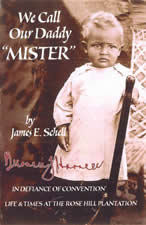
This is a revised edition of We Call Our Daddy "Mister". The book covers the story of a Southern family in which the Father is white and the Mother is mulatto. Interracial marriage was forbidden by law and custom at the time (cc. 1890-1955). Social "interplay" was not openly existent among the races. Their common law marriage produced nine children: 5 boys and 4 girls most of whom appeared lily-white throughout their lifetime but were considered colored or black and therefore often suffered from the brutal treatment meted out to the black populations. These children found it difficult to cope in many of their endeavors but none chose to pass for white even though they could have easily done so. Nonetheless, the father, Burrell Harrell, a wealthy farmer owning more than 2000 acres, 500 head of cattle, and was the most prominent cotton grower in the area insisted that the townspeople accord his children all of the rights and privileges given to the whites, many times failing as the children were relegated to separate and unequal segregated schools and public accommodations. Theirs was not always the worse as they did seat themselves among the whites at the local picture show. This is a true story which was introduced to the public at the Cobb Archives of the Chambers County Public Library in Valley, Alabama, December 7, 2006. "We Call Our Daddy "Mister" is still featured on Amazon.com; however, it will be again be featured on www.itascabooks.com,and many others. It can be ordered now from: Dr. Schell's book was the main feature in the Morehouse College magazine First quarter, 2007. He appeared for a book signing at Morehouse during Founder's Week activities February 15-18, 2007. SUMMARY OF ENGAGEMENTS: Presentations have been made by your author continually throughout California, fraternal organizations and College campuses throughout the USA on demand. Such may be resumed in the near future.. Consult the schedule below for prices and details for ordering and shipment. FEB 2008 SEP 2008 Rutledge Family Reunion (maternal branch of the Winston/Harrell Family, Detroit FEB 2009 Morehouse College, Founders Day Event, English Writing Class, Booksigning Lithonia (GA) Elementary School, Storytelling for 5th Graders, Book Fair JULY 2011 Sigma Pi Phi Fraternity outing, San Jose, CA JULY 2012 Release of Second Edited of We Call Our Daddy "Mister" |
||
Synopsis of We Call Our Daddy “Mister”
This is a non-fiction story of a prominent Georgia, pioneer family’s son, a farmer, whose father was a Confederate soldier, who “took up” with a “mulatto” lass to be his common-law wife. Burrell Harrell and Rosa Winston lived together in the early 1900’s in defiance of Georgia’s anti-miscegenation laws. They became the proud parents of five boys and four girls over a stretch of 20 years, remaining on the family’s plantation of nearly 2000 acres. His father died in 1901. Burrell was then only 17 years old. From his father’s deathbed, Burrell promised he would take care of his four brothers, three of whom were older, and five sisters, two of whom were older, as well as his mother, and a legion of farm hands up from slavery. His immediate family not only refused to accept his relationship with Rosa but also denied its existence, although Burrell was indispensable to their well-being but through, disdain, daring, derring-do, and even deceit, he ruled the roost.
Their children were “white” in appearance showing absolutely no features of their mixed race, yet the laws forbade them to attend the white school and to enjoy the many rights and privileges reserved for whites. This story courses through their many struggles as they grew up, and how their father successfully staves off so many of those challenges including attempts by the KKK to do harm to his family; however, he, himself, was conflicted about his own children’s race. His upbringing, loyal to the precepts of the Confederacy disabled his acceptance of them as equal to his own kind. Burrell managed this vast plantation for nearly 60 years before passing control of the plantation not to his own sons but to the eldest living white male, a nephew, Roy. Roy was the son of Burrell’s slain but profligate brother. Burrell felt that the white power structure would not be fair to his children and left the task to Roy, an inveterate confederate. At this writing, all of Burrell Harrell's and Rosa Winston's children have passed away. |